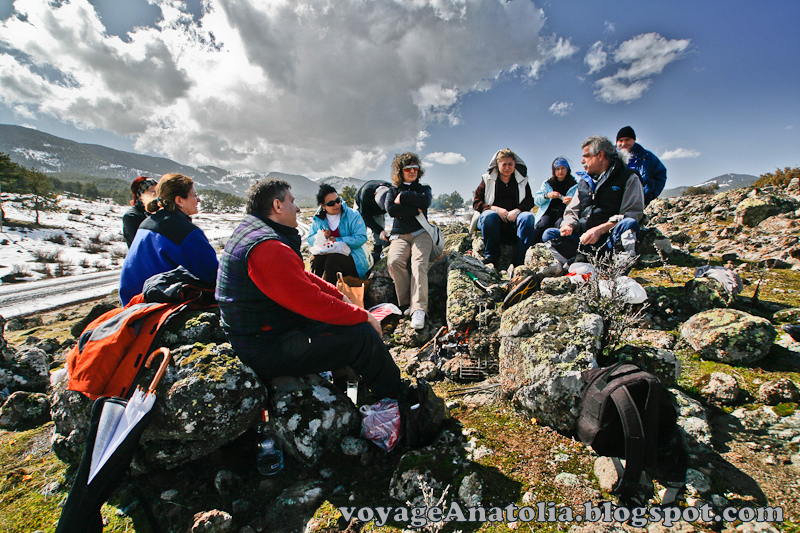
AFSAD Photography School at work for nature class at Bolu Mountains, around campfire, well actually barbeque fire I should say...
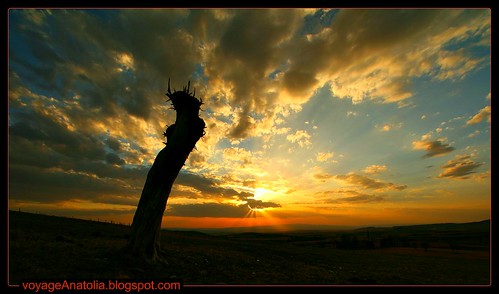
The rule of thirds is a compositional rule of thumb in visual arts such as painting, photography and and design. The rule states that an image should be imagined as divided into nine equal parts by two equally-spaced horizontal lines and two equally-spaced vertical lines, and that important compositional elements should be placed along these lines or their intersections. Proponents of this technique claim that aligning an image with these points creates more tension, energy and interest in the photo than simply centering the feature would.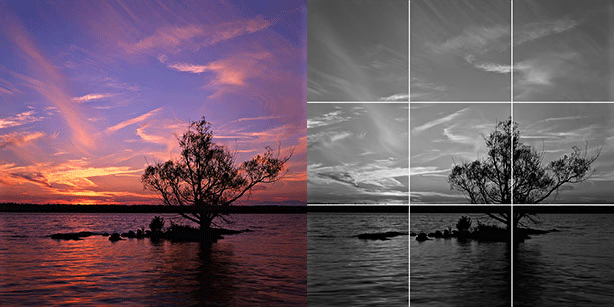 The photograph to the right demonstrates the application of the rule of thirds. The horizon sits at the horizontal line dividing the lower third of the photo from the upper two-thirds. The tree sits at the intersection of two lines, sometimes called a power point. Points of interest in the photo don't have to actually touch one of these lines to take advantage of the rule of thirds. For example, the brightest part of the sky near the horizon where the sun recently set does not fall directly on one of the lines, but does fall near the intersection of two of the lines, close enough to take advantage of the rule.
The rule of thirds can be applied by lining up subjects with the guiding lines, placing the horizon on the top or bottom line instead of the center, or allowing linear features in the photograph to flow from section to section. In addition, many photographers recommend treating any "rule" of composition as more of a guideline, since pleasing photographs can often be made while ignoring one or more such rules.
When photographing or filming people, it is common to line the body up with a vertical line, and having the person's eyes in line with a horizontal one. If filming a moving subject, the same pattern is often followed, with the majority of the extra room being in front of the person (the way they are moving).
This works so that the subject is not surrounded by too much empty space.
Source: Wikipedia.org

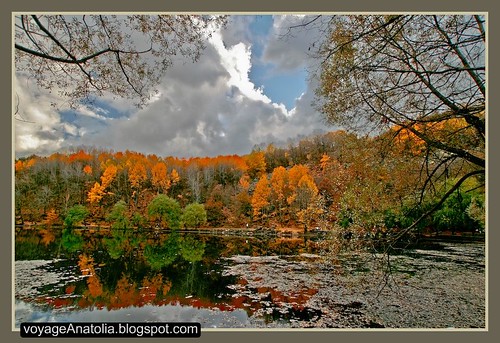
AFSAD Photography School, Nature Photography Class at Lake Sünnet near Göynük, Bolu, Turkey.
