Image sensors used in DSLRs come in a range of sizes. The very largest are the ones used in "medium format" cameras, typically via a "digital back" which can be used as an alternative to a film back. Because of the manufacturing costs of these large sensors are quite expensive.
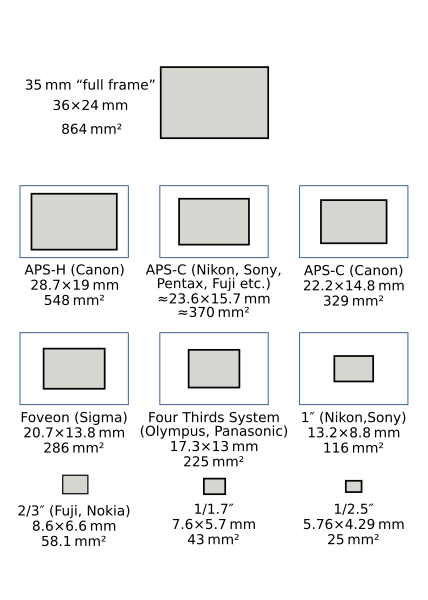
With the exception of medium format DSLRs, the largest sensors are referred to as "full-frame", and are the same size as 35 mm film (135 film); these sensors are used in quite expensive DSLRs such as the Canon EOS-1Ds Mark III, the Canon EOS 5D, the Nikon D700, the Nikon D3, and the Sony Alpha 900. Most modern DSLRs use a smaller sensor commonly referred to as APS-C sized, that is, approximately 22 mm × 15 mm, a little smaller than the size of an APS-C film frame, or about 40% of the area of a full-frame sensor. Other sensor sizes found in DSLRs include the Four Thirds System sensor at 26% of full frame, APS-H sensors (used, for example, in the Canon EOS-1D Mark III) at around 61% of full frame, and the Foveon X3 sensor at 33% of full frame.
The sensors used in current DSLRs are much larger than the sensors found in digicam-style cameras, most of which use sensors known as 1/2.5", whose area is only 3% of a full frame sensor. Even high-end digicams such as the Canon PowerShot G9 or the Nikon CoolPix P5000 use sensors that are approximately 5% and 4% of the area of a full frame sensor, respectively. The one current exception is the Sigma DP1, which uses a Foveon X3 sensor.
Leica offers an "S-System" DSLR with a 30x45mm sensor containing 37-million pixels. This sensor is 56% larger than a full-frame sensor.
There is a connection between sensor size and image quality; in general, a larger sensor provides lower noise, higher sensitivity, and increased latitude and dynamic range. There is also a connection between sensor size and depth of field, with the larger sensor resulting in shallower depth of field.
References:
http://en.wikipedia.org/wiki/Digital_single-lens_reflex_camera
http://en.wikipedia.org/wiki/Image_sensor_format